
It’s Saturday morning at Cars & Coffee. You bought your 2003 Carrera three weeks ago, and you’re proud of it. A guy with a GT3 walks over, looks at your car, and asks one question: “Has the IMS been done?” You nod. You have no idea what he means. Here’s what he meant.
What is the IMS bearing?
The intermediate shaft (IMS) sits inside the engine and helps drive the camshafts. It rides on a sealed bearing. On certain Porsche engines built roughly from 1997 to 2008, that bearing can wear out. When it fails, it can take the timing with it and badly damage the engine.
Most of these cars never have a problem. But when one does fail, it’s usually expensive, which is why the question comes up at every car meet.
Which Porsches are affected?
The concern applies to the water-cooled M96 and M97 flat-six engines. That generally includes:
- 911 (996): Carrera models, roughly 1999 to 2005
- 911 (997.1): Carrera models, roughly 2005 to 2008
- Boxster (986 and early 987): roughly 1997 to 2008
- Cayman (early 987): roughly 2006 to 2008
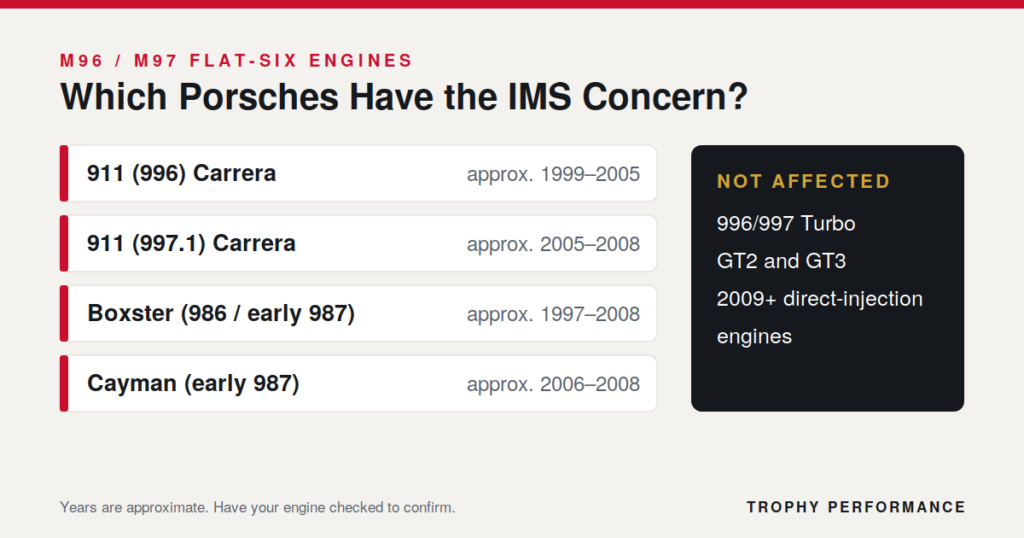
The 996 and 997 Turbo, GT2, and GT3 use a different engine design and aren’t part of this concern. Porsche’s newer direct-injection engines, introduced around the 2009 model year, did away with the traditional IMS bearing.
Not every car in those year ranges uses the same bearing. Some later engines use a larger bearing that can’t be replaced without taking the engine apart. The only way to know exactly what’s in your car is to have someone who knows these engines check it.
Warning signs to watch for
An IMS problem doesn’t always warn you. When it does, signs can include:
- Metal particles in the oil filter
- A new rattle or grinding noise from the back of the car
- A check engine light for cam timing faults
If you notice any of these, stop driving and have the car inspected.
How to protect your engine
- Change your oil more often. Fresh oil is the bearing’s best friend. Many owners cut the factory interval roughly in half.
- Have the oil filter cut open and inspected. Metal in the filter is an early warning.
- Drive the car. Cars that sit for long periods may be at higher risk than cars driven regularly.
- Consider a bearing upgrade. On engines where it’s possible, an upgraded bearing can be installed. Many owners do it while the clutch is already being replaced, since the work overlaps and saves labor.
Get a straight answer at Trophy Performance
If you own one of these cars, or you’re thinking about buying one, Trophy Performance can tell you what bearing your engine has, check the oil filter, and talk through your options honestly. Not every car needs the upgrade, and we’ll tell you if yours doesn’t. Call: 702-731-1110